Synopsis: Ancient Chinese Inventions: A review of ancient technological inventions together with a consideration of the Antikythera Mechanism, the Baghdad Battery and other violations of accepted world history.
"There is at least one artefact that proves
beyond all doubt that one civilisation in the ancient world possessed technical knowledge which no modern scientists had previously suspected. As it was found
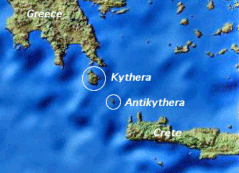
in the sea off Antikythera, a small island north west of Crete, it is known as
the Antikythera Mechanism." (1) So wrote renowned author and skeptic Arthur C.
Clarke of an artefact that remains a puzzle to our accepted view of world
history. Check out our video here.
In 1900, on the
day before Easter Sunday, a team of divers discovered a shipwreck off Antikythera (left whilst attempting to find sponges.
The sunken ship’s hull was full of bronze statues and other ancient artefacts
that were later retrieved and delivered to the National Archaeological Museum in
Athens for cleaning and restoration. It was not until 17th May 1902
that a leading archaeologist examined the artefacts and recognised the outline
of cogwheels in one of the lumps of bronze and wood. The writing on the case
confirmed that the item had been made in 80 BCE.
In 1958 Derek J. Solla Price, an Englishman
who then worked at Cambridge University and who later worked as the Avalon
Professor of the History of Science at Yale University in America, examined the
mechanism. Using a process for restoring oxidised objects, Dr. Price was able to
salvage some of the mass and from these pieces he attempted to rebuild the
device.
However it was not until 1971 when X-ray
photographs were taken of the artefact by the Greek Atomic Energy Commission,
that the mechanism's array of meshing gears was finally revealed (2,3). Price
remarked that, "nothing like this instrument is preserved elsewhere. Nothing comparable to it is known from any ancient
scientific text or literary allusion. On the contrary, from all that we know of
science and technology in the Hellenistic age, we should have felt that a device
could not exist". (4)
Work on the artefact revealed that on the outside it had
consisted of dials set into a wooden box with at least 20-gear wheels inside.
The box was covered with inscriptions that included an astronomical calendar.
The mechanism also included a system of differential years. A
crank spindle set the gears in motion at various speeds, turning pointers on
three dials that calculated the rising and setting times and phases of the Moon,
and the positions of the planets Mercury, Venus, Mars, Jupiter and Saturn all
with a high degree of accuracy (5). "It appears that this was, indeed a
computing machine that could work out and exhibit the motions of the sun and the
moon and probably also the planets" Solla Price stated (6).
Arthur C Clarke, wrote of the device in ‘Technology and the Limits
of Knowledge’ in ‘The View from Serendip’, "Looking at this
extraordinary relic is a most disturbing experience. Few activities are more
futile than the ‘what if....’ type of speculation, yet the mechanism positively
compels such thinking.
Though it is over two thousand years old, it represents a level which our
technology did not reach until the eighteenth century…If the insight of the
Greeks had matched their ingenuity, the industrial revolution might have
begun a thousand years before Columbus. By this time we would not merely be
pottering around on the Moon, we would have reached the nearer stars.’" (7)
Check out the video for more information here.
Other artefacts have been discovered that further illustrate that our
ancestors enjoyed a degree of technology that should have been unavailable to
them. One of the most intriguing of these artefacts has been called the
Baghdad Battery.
In the late 1930’s Dr. Wilhelm König, a German archaeologist
employed by the State Museum in Baghdad was examining a consignment of finds
from a settlement that had once been occupied by the Parthians. König wrote
"something rather peculiar was found, and, after it had passed through several
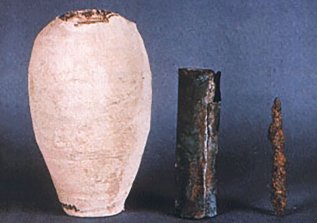
hands, it was brought to me. A vase like vessel of light yellow clay, whose neck
had been removed, contained a copper cylinder, which was held firmly by
asphalt.
"The vase was about 15 centimetres high; the sheet-copper cylindrical tube with bottom had a diameter of 26 millimetres and
was 9 centimetres long. In it, held by a kind of stopper of assault, was a
completely oxidised iron rod, the top of which projected about one centimetre
above the stopper and was covered by a yellowish grey, fully oxidised thin
coating of a metal which looked like lead. The bottom end of the iron did not
extend right to bottom of the cylinder, on which was a layer of asphalt about
three millimetres deep.
"The question as to what this might be received the most
surprising answer. After all the parts had been brought together and then
examined in their separate parts, it became evident that it could only have been
an electrical element. It was only necessary to add an acid or an alkaline
liquid to complete the element. (8)" The Baghdad Battery, was constructed
between 248BCE and 266AD making it around two thousand years old.

Confirmation of the artefact as an electric cell came from
Dr. Arne Eggebrecht (left), an Egyptologist from Hildesheim in Germany and from
science historian, Willy Ley, working with of the General Electric High Voltage
Laboratory in Pittsfield, Massachusetts. Ley constructed a duplicate model of
the artefact and discovered that when copper sulphate, acetic acid or citric
acid were added, the cells produced between 1.5 and 2 volts of electricity.
Generation of electric current by the same means was not achieved by our modern
civilisation until the early 19th century.
The Baghdad Battery was not a ‘one-off’ with four similar clay
pots containing copper cylinders being unearthed in a hut near Baghdad. In these
pots were thin iron and copper rods which may have been used to connect
themselves together to deliver a higher voltage. Ten other cells were also
uncovered at Ktesiphon by Professor E. Kuhnel of the Staatliches Museum in
Berlin. Check out the video here.
Having established that early man knew of, and used
electricity, the strange engravings at different locations within the Late
Ptolemaic Temple of Hathor at Dendera in Egypt become easier to explain.
In chamber seventeen of this temple, there is a panel that
appears to depict Egyptian priests ‘operating’ tube like devices. Each tube has
something extending its full length inside. In the opinion of a classical
archaeologist, Dr. John Harris of Ashmolean Museum of Oxford University, there
is nothing out of the ordinary in this, and he believes the ‘something inside’
is an image of a serpent. He argues that the ‘snake-stones’ were set up on
either side of entrances to temples or rooms assigned for a snake cult.
However Swedish writer, Ivan Troëng, who knew little of
Egyptian lore, noted in his book ‘Kulturer Fore Istiden’ that "the
picture … obviously shows electric lamps held by high tension insulators". This
idea was explored further by a fellow Swede, engineer Henry Kjellson in his book
‘Disappeared Technology’ (Published as ‘Forvunen Teknik’).
Kjellson noted that in the hieroglyphs, these ‘snakes’ are translated as
‘seref’, which means to glow. Kjellson therefore concluded that there is some
form of electrical current involved in the apparatus depicted. In the scene, to
the extreme right there is a box on top of which is sitting an image of the
Egyptian god Atum-Ra, which identifies the box as the energy source.
Attached to the box is a braided cable which
electromagnetics engineer Alfred D. Bielek identified as a copy of engineering
illustrations used today for representing a bundle of conducting electrical
wires.
The cable runs from the box, the full
length of the floor of the picture and ends at the bases of the tube objects.
These objects each rest on a pillar called a ‘djed, which Bielek believes
to be a high voltage insulator.
Although some scenes in the
upper chambers of the temple have been damaged by vandals, other pictures found
in a lower crypt are almost perfectly preserved and further add to the puzzle.
In one image, not
only are the tubes shown in full operation, but something has been added which
may provide a clue to what the tubes were actually for. In several instances,
both men and women are shown sitting underneath the tubes, hands held out and
cupped, suggesting a receptive mode (below).
It has been suggested that they were
engaged in radiation treatment. Unfortunately, Bielek,
himself is open to greater skepticism, having made, over the years a number of
outlandish claims regarding time travel etc that question his authority however,
despite these concerns, the images are certainly open to this
interpretation. Check out the video here to determine for yourself.
As bizarre as this sounds there is supporting evidence in
historical scripts for the need for such treatment. The Mausola Parva or
Mahabharata, an ancient Indian sacred writing, refers to a thunderbolt ‘a
gigantic messenger of death’ which reduced whole armies to death and caused the
hair and nails of survivors to fall out. Pottery broke without cause and birds
turned white. Later foodstuffs became poisoned. The Drona Parva, another ancient
Indian text, notes "A blazing missile possessed of the radiance of smokeless
fire was discharged. A thick gloom suddenly encompassed the heavens. Clouds
roared into the higher air, showering blood. The world, scorched by the heat of
that weapon, seemed to be in fever." Another passage of the text compares the
detonation with a flare of ten thousand suns (9).
Of course this may simply be an account which to modern
ears sounds remarkably like atomic fall-out but isn’t, yet there is residual
supporting physical evidence. For example the surface of the Gobi Desert near
Lob Nor lake is covered with vitreous sand - the result of China’s atomic
testing - but the desert had other areas of glassy sand which have been present
for many thousands of years. The source of this intense heat in pre-history
remain as unknown. There are also ancient burnt stones and boulders in the Sinai
desert that have not been adequately explained.
It is
difficult to believe that mankind itself possessed atomic technology however
there is evidence to suggest that he may have possessed more mundane, but
nevertheless still forbidden (time-wise), weaponry. The source of these claims
stems from this apparently unremarkable several thousand-year-old skull of an
aurochs, a type of bison now extinct at the Russian Paleontological Museum in
Moscow.
What is remarkable,
however, is that in the forehead of the animal there is a small round hole. A
hole with an almost polished appearance - and without radial cracks. It has been
suggested that the hole could only have been created by a projectile travelling
at a very high speed, and the only natural phenomena that could account for the
size and speed would be a small meteorite. Yet such a meteorite would have burnt
up long before hitting the ground. Logically therefore, whatever caused the hole
must have been artificial in construction.
Given our accepted
world history, it is impossible that something artificial could have breached
the animal’s skull several thousands of years ago. Therefore, there must be a
third explanation and the only one would appear to be that, for whatever reason,
the skull of the now extinct animal was discovered and injured within last few
hundred years.
However, this
explanation, however bizarre, cannot be true either, for there is no doubt that
the aurochs was alive when its skull was breached; the calcification around the
aperture is evidence of that. Indeed, the animal survived the wound and died
years later from other causes, leaving a significant puzzle.
This discovery of hole in the extinct aurochs is similar to
that found in the skull of a 40,000-year-old Neanderthal discovered near Broken
Hill in Rhodesia in 1921. On the left of the skull is a perfectly round hole.
There are no radial cracks that would have resulted had the hole been caused by
a weapon such as an arrow or a spear. Again, only a high-speed projectile such
as a bullet could have caused the aperture.
Indeed, further evidence of the bullet theory comes from the
fact that the skull area directly opposite the hole is shattered, having been
blown out from the inside. No projectile slower than a bullet could have
produced either the neat hole or the shattering effect and a German forensic
scientist from Berlin has confirmed that the cranial damage to the skull could
not have been caused by anything but a bullet.
It could be argued, that someone, for some reason, decided to
shoot the skeleton leaving behind only a minor mystery, or, as opposed to the
aurochs (which is known to be extinct), the skull is not as old as it is claimed
to be. Neanderthal man's skull, however, cannot be easily mistaken for modern
man's style, and this skull in particular, has been exhibited at the Museum of
Natural History in London, were a mistake is unlikely to have been made. The
skeleton was also found 60 feet below the surface; only a period of several
thousand years could account for the accumulation of such a deposit.
As with the mysteries detailed in the previous chapter, these
puzzles appear out of context with our knowledge of world history, again
suggesting that perhaps our history should be rewritten to accommodate all known
facts, not just the ones that fit comfortably into our accepted view and
understanding.
A rewriting of history becomes all the more pressing when we
look back beyond the dark-age; for when we do so it suddenly becomes apparent
that modern man has only re-created what has gone before and any pride on
building a ‘sophisticated’ world should be replaced with a degree of puzzlement
at how we lost our earlier knowledge, skills and technologies. Far from making
steady progress, the last 12,600 years actually appears to represent the descent
of man.
This can be demonstrated in many ways and should actually
come as no surprise for many of the problems we face in organising our lives and
society are timeless; they were as pertinent thousands of years ago as they are
today. For example, the ancient Romans would change their street arteries to one
way during peak traffic hours, and the city of Pompeii (left) used arm-waving
traffic policemen to cope with the congestion. Street signs were used in Babylon
more than two and a half thousand years before the present, with catchy names
such as ‘The Street On Which No Enemy Ever Tread’.
We now know the ancient city of Antioch was the location of the
first street lighting known in history and that the Aztecs set a permanent
coloured strip directly into the paved road in order to divide the two lanes of
traffic (whilst our roads only have painted lines to achieve the same effect.)
Excavations at Mohenjo Daro, Harappa and Kalibanga in Pakistan and India also
show that town planning was in existence 4,500 years ago; the streets of these
ancient cities were straight and the blocks rectangular. A complex water supply
and drainage system was also discovered.
Similarly there is evidence of a complex underwater system in
the ancient ruins of Chavin
de Huantar high in
the Peruvian Andes, dating to 500 BCE. At its peak, Chavin de Huantar (right)
covered 105 acres and its population numbered around 3000, an unusually large
size for Peru at the time (10).
Archaeological constructions of the main ceremonial area of the
site show a series of temples that rank amongst the oldest in the world, with
one principle temple (11). Under Chavin de Huantar lies a network of finely
constructed stone channels that drew water from a nearby river and carried it
underneath the site by way of a sophisticated hydraulic system (12).
Four thousand years ago wealthy Koreans had Spring Rooms
warmed by hot air, which circulated in vents under the floors, and the
Romans used a similar design. (Recent central heating was only invented towards
the end of the 17th Century by Bonnemain and perfected by
Duvoir.)
At the same time in history private toilets with a central
system of stone drains and ceramic pipes were common in the city of Knossos,
Crete (left). Similarly the rooms of the Palace of Minos were ventilated through
air-shafts. With its air-conditioned chambers, excellent bathrooms and toilets,
the palace was not only modern in the way it was equipped, but also very large;
similar in size to Buckingham Palace. Pipes for hot and cold water have also
been found in tiled bathrooms at Chan Chan in South America a time when such
comforts were unheard of in Europe.
Not only did the infrastructure of some buildings compare
favourably with modern day equivalents, but also their furnishings: The
prehistoric city of Catal Huyuk in Turkey is over 8,500 years old, yet pieces of
carpet have been found in the ruins that could compete well with the best woven
carpets available today. Such skills were equally evident in a discovery made by
Professor Luther S. Cressman of the University of Oregon who came across two
hundred pairs of skilfully made woven-fibre sandals in Lamos Cave in east
Nevada. When a carbon-14 test was made, the sandals were found to be well over
9000 years old (13).
TAGS: Ancient Chinese Inventions, Review Ancient Chinese Inventions, Ancient Technological Inventions, Antikythera Mechanism, Baghdad Battery, Violations of Accepted World History