|
Secrets of the Third Reich
Nazi UFO: A review of supressed Nazi UFO evidence detailing secrets of the Third Reich and German technological advances towards the end of World War II.
The fact that the Germans were developing advanced
technologies during the end of the war is a matter of public record. As Sir Roy Feddon, Chief of the Technical Mission to Germany for the Ministry of Aircraft
Production stated in 1945. "…I have seen enough of their designs and production
plans to realise that if they (the Germans) had managed to prolong the war some
months longer, we would have been confronted with a set of entirely new and
deadly developments in air warfare."
Captain Ruppelt, Chief of the US Air Force Project Bluebook
added in 1956, "When WWII ended, the Germans had several radical types of
aircraft and guided missiles under development. The majority were in the most
preliminary stages, but they were the only known craft that could even approach
the performance of objects reported to UFO observers…"
Some of these German war-time technical advances were well
known. The first military jet was the German Heinkel 178 that flew in 1939. In
1943 the Germans also deployed the only jet fighter to go into regular service
during the war, the Messerschmitt 262.
This jet could easily overtake the fastest Allied aircraft, yet fortunately
Hitler ordered that these planes should be fitted as bombers rather than
defensive fighters which saved Allied aircraft from devastating casualties.
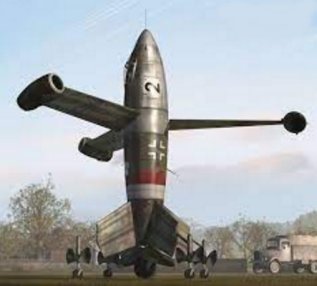
Then Heinrich Focke was involved in the design of and
production of the FW6, Fa223, Fa226, Fa283 and 284 models during the war. He
designed a propulsion system known as the ‘turbo-shaft’, which is still used in
most helicopters today. Using this technology, Focke designed this upright,
vertical take-off aircraft, which was just coming off the drawing board as the
war ended. At the end of each of the three long arms of this technologically
advanced craft was a small jet propulsion unit. The rotating arms were used to
lift the body from the ground like the blades of a helicopter.
|
|
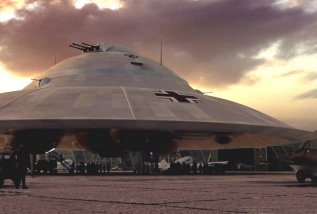
In 1939 Focke patented a saucer-shaped craft with enclosed twin
rotors described as follows: "The exhaust nozzle forked in two at the end of the
engine and ended in two auxiliary combustion chambers located on the trailing
edge of the wing. When fuel was
added these combustion chambers would act as afterburners to provide horizontal
propulsion to Focke’s design. The control at
low speed was achieved by alternatively varying the power from each auxiliary
combustion chamber."
Cruise missiles were also first used by the Third Reich and
V-1 bombs were launched from German occupied territories across the channel into
England.
The next German rocket, the V-2 proved to be the predecessor of the
Intercontinental Ballistic Missiles that filled the arsenals of the former
Soviet Union and US during the Cold War. This missile could travel 225 miles at
five times the speed of sound and a single hit could take out a city block.
The Germans also developed a rocket-powered fighter, the ME 163 and although it
was never put into regular service, it was the first aircraft to fly faster than
600 miles per hour. These then, were some of the known German advances. However
there were also hints of darker technologies not fully understood. It was in
1944 that knowledge of these became public for the first time when the New York
Times of 14th December reported "Floating Mystery ball is New German
Weapon.
|
"Supreme Headquarters, Allied Expeditionary Force, Dec 13
- A new German weapon has made its appearance on the western air front, it was
disclosed today. Airmen of the American Air Force report that they are
encountering silver coloured spheres in the air over German territory. The
spheres are encountered either singly or in clusters. Sometimes they are
semi-translucent." (1)
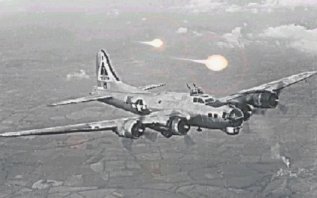
A typical incident was reported by a veteran pilot of the
415th Night Fighter Squadron. He was flying a mission over Hagenau,
Germany on 22nd December 1944 when at 6.00am, whilst flying at an
altitude of ten thousand feet, the pilot and his radar operator saw two "large
orange glows" rapidly climbing towards them.
"‘Upon reaching our
altitude’ the pilot reported, the objects ‘levelled off and stayed on my tail.’
He went into a steep dive and the ‘glows’ followed in sharp precision. He banked
as sharply as he dared and the objects followed. For two minutes the ‘lights’
stalked the fighter through several intricate manoeuvres, peeled off under
perfect control, then blinked out…" (2)
The purpose of these strange objects was a mystery, for
they merely followed warplanes, but apparently never opened fire or otherwise
attacked them. These objects were named ‘Foo Fighters’, a term which came from a
headline ‘Where There’s Feu, There’s Fire.’
Each side in the war seemed to
believe that the Foo Fighters were the inventions of their enemy and several
reconnaissance missions were launched to gain further information. To date, it
has never been clearly established where the technology came from, and the
origins of the foo-fighters remain an historical puzzle alongside the
Scandinavian ghost rockets. What was clear, however, was that it wasn’t Allied
technology, and that was a serious cause of concern. Check out more here.

Over the years fact and fiction regarding the exact nature of
these advanced German technologies have become fused, however it is now clear
that the Germans were developing craft that could be mistaken for what would
nowadays be considered UFOs. In fact, such developments make perfect sense:
Each side during the war relied heavily on their aerial
capabilities, and one sure way to disable such abilities was to take out enemy
runways. Either side could have had the best air fleet on the planet, but
without somewhere to take off from, such a fleet was impotent.
|
|
Therefore
the development of craft that did not require any runway, like Focke’s designs,
could potentially alter the eventual course of the war. As it turned out, the
designs were only coming on line as the war ended, but had the conflict
continued, it is conceivable that these new technologies could have altered the
shape of history.
However, exactly what was being developed is now less a
matter of historical record, and more of an historical jigsaw, with not only
pieces missing, but other pieces conceived in the minds of writers who then
peddled fictitious Nazi flying saucer myths to those who chose to believe them.
Establishing fact from fiction from over fifty years ago is no
easy matter, and we are forced to consider information that is largely
unverifiable. Yet when pieced together a plausible story of Nazi flying disk
technology does begin to emerge.
One person who made claims regarding the development of ‘flying
saucers’ in Nazi Germany is former Luftwaffe Flight Captain and aircraft
designer Rudolph Schriever. He claimed in 1950 that he and a small team had
worked at facilities near Prague developing a saucer-type vehicle.
This story first appeared in ‘Der Spiegel’ magazine on
30th March 1950 in an article entitled ‘Untertassen-Flieger Kombination’ which
stated "… Rudolph Schriever, who says engineers throughout the world
experimented in the early 1940s with flying saucers, is willing to build one for
the United States in six to nine months. The
40-year-old Prague University graduate said he made blueprints for such a
machine, which he calls a flying top, before Germany’s collapse and that the
blueprints were stolen from his laboratory.
He says the machine would be capable of 2,600mph with a radius of
4,000 miles, Schriever is a US Army driver at Bremerhaven." (3)
His claims are backed up by a 1975 Luftfahrt International
Report that noted that after Shriever’s death in the late 1950s, papers found
amongst his belongings revealed incomplete notes for a large flying saucer, a
series of sketches of the machine and several newspaper clippings of himself and
his alleged flying saucer. Up to his death, Schriever had repeatedly claimed
that the UFO sightings since the end of the war were proof that his original
ideas had been taken further with successful results.
Researcher Bill Rose was able to discover that Schriever
was involved with other scientists Klaus Habermohl and Giuseppe Belluzzo (an
Italian engineer) as well as one Dr. Walter Miethe. Rose’s research established
that Miethe had been the Director of the saucer programme at two facilities
located outside Prague. We know little more about Miethe’s activities at this
time him but it does seem that he knew Wernher von Braun (of whom much more
later) as there is a photograph of them together in 1933.
|
We certainly do know that one scientist, Viktor Schauberger,
was involved in the production of flying disks, and that he flew one in 1945
near Prague, just as Schriever had claimed. His experimental prototypes were
based on levitation. Born in 1885, Schauberger considered the natural world his
greatest teacher although many in the world considered Schauberger to be
somewhat deranged. In forests, alongside rivers, he studied what he considered
life-enhancing energy, water and air vortices.
He argued that "Prevailing technology uses the wrong forms of
motion. It is based on entropy – on motions which nature uses to break down and
scatter materials. However, nature uses a different type of motion for creating
order and new growth. The prevailing explosion-based technology – fuel burning
and atom splitting – fills the world with expanding, heat-generating centrifugal
motion." Schauberger believed that energy production could instead use
inward-moving cold-generating centripetal motion, the same as nature employs to
build and enliven substances. Even hydroelectric power plants, Schauberger said,
use a destructive motion – they pressure water and chop it through turbines. The
result is ‘dead water’. He built suction turbines that he considered enlivened
and invigorated, resulting in clean, life-giving water downstream.
Schauberger also produced electrical power from a unique
suction turbine using implosion principles and was later pressured into
developing a propulsion system using the same principles applied to air. His work came to Hitler’s attention and his son (left)
recounts the meeting between his father and Hitler: "In June of 1934 my father
was invited by the Reich’s Chancellor Adolph Hitler to discuss his work. Hitler
wanted to know about his discoveries and talk about the various possibilities
and what his great plan was. And he said ‘yes, I’m looking for a new technology
that must once again harmonise with the natural order of things and that is my
real programme.’
"Shortly before the meeting, Hitler as Reich Chancellor gave
the two deputies his orders. The two had come to discuss Herman Goering’s plan.
And he said ‘Viktor Schauberger, you will speak with the two Reich’s deputies
and tomorrow or by the latest the day after tomorrow a second meeting will take
place. And he said to the two deputies ‘I find the plan fascinating. Yes, we
Germans will bring about a whole new science.’" (4)
Hitler wanted Schauberger to supervise the building of a
new flying craft that could levitate without burning any fuel. This idea for
this new craft was based upon a discovery made by Schauberger a few years before
of how to develop a low-pressure zone at the atomic level. The scientist claimed
to have achieved this in a laboratory setting when his prototype whirled air or
water ‘radically and axially’ at a falling temperature. Schauberger named this
resulting force as ‘diamagnetic levitation power’ and noted that nature already
used this direct or ‘reactionary’ suction force in weather generation, solar
fusion stability etc.
Schauberger was given a team of scientists to help him with his
work, and he insisted that these be treated as free men rather than prisoners of
the Nazis. During their work, however, their research headquarters was bombed
and they were all transferred to Leonstein. There they perfected the ‘flying
disc’ powered by Schauberger’s turbine which rotated air into a twisting type of
oscillation resulting in the build-up of immense power causing levitation.
Schauberger’s prototype was then developed into a vehicle known as the
Belluzzo-Schriever-Miethe Diskus, a machine built up to 22ft in diameter. These
craft travelled at over 2000 km/hr and were planned to go over 4,000 km/hr. By
1945 they could reach 1300 mph and gain an altitude of 40,000 feet in less than
three minutes. The craft was also noted to glow blue-green as it rose and left a
silvery glow.
The Munich publication, ‘Da Neue Zeitalter’ wrote in
1956 "Viktor Schauberger was the inventor and discoverer of the new motive
power, implosion, which, with the use of only air and water, generated light,
heat and motion."
The publication reported that the first unmanned flying disc,
what to an observer would have appeared to be Nazi UFOs, was tested in 1945 near Prague, that it could hover motionless in the air and
could fly as fast backwards as forwards. It was also reported to have a diameter
of 50 meters.
Other evidence in support of this event had appeared earlier in an
interview given on 18th November 1954 to the Zurich-based ‘Tages
Anzeiger’. One George Klein stated that he had witnessed
Nazi UFOs flying saucer
test on 14th February 1945 and that the craft had reached a height of 30,000
foot in three minutes and could travel at hundreds of miles an hour.
In this interview, Klein gave further information regarding
developments behind the disks, claiming that some of the work had taken place at
Peenemunde, where the V-2 rocket was being developed and where Wernher von Braun
was director.
Klein also stated that the stability of the craft had been
achieved by using a gyroscope; the same method used by the Von Braun-Dornberger
team. The research then moved to the Mittlewerke underground facilities near
Nordhausen in the Harz Mountains.
The ‘Bible’ of the story of the development of the Atomic bomb,
‘Brighter than a Thousand Suns’, also confirms these events: "The first
of these flying saucers, as they were later called – circular in shape, with a
diameter of some 45 yards – were built by the specialists Schriever, Habermohl
and Miethe. They were first airborne on February 14th 1945, over
Prague and reached in three minutes a height of nearly eight miles. They had a
speed of 1250mph which was doubled in subsequent tests." (5)
That these events occurred is also supported by former CIA
agent Virgil Armstrong who commented "We know that in the early parts of the war
there were certain factions of the Allied forces that did not believe he had a
secret weapon and it wasn’t until the Americans made much emphasis of this that
they began to look at it seriously and indeed did discover that Hitler not only
had a secret weapon, he had what we would call today a UFO or spacecraft."
TAGS: Nazi UFO, Nazi UFO Evidence, Secrets of the Third Reich, German Technological Advances, World War II, Suppressed Nazi UFO Evidence

 |