Synopsis: UFOs of the Third Reich: Allegations of Nazi UFOs of the Third Reich abound and are supported by evidence of the Hannebu flying disk together with the secretive Operation Paperclip.
"He had one already off of
the drawing board and flying and it was capable of 1200 miles an hour. Vertical
take-off, 90° changes, much like a helicopter, and of course was far superior to
anything the Allies powers had at that time.
Secondly they knew he had another craft about to be up and going it was capable
of doing 2500 miles per hours, which was double the original. Not only did it
have the characteristics of the original craft, but it also had a laser weapon
aboard it which capable of penetrating four inches of armour.
Needless to say that really spooked the allied forces into making a redemptive
attempt against him and bringing him … into a state of capitulation." (6)
Bulgarian Physicist Vladimir Terziski also wrote the following
about these Nazi UFOs. "According to Renato Vesco … Germany was sharing a
great deal of the advances in weaponry with their allies the Italians during the
war. At the Fiat experimental facility at Lake La Garda, a facility that
fittingly bore the name of Air Marshall Hermann Goering, the Italians were
experimenting with numerous advanced weapons, rockets and airplanes, created in
Germany.
In a similar fashion, the Germans kept a close contact with the
Japanese military establishment and were supplying it with many advanced
weapons. I have discovered for example a photo of a copy of the manned version
of the V-1 – the Reichenberg – produced in Japan by Mitsubishi. The best fighter
in the world, the push-pull twin propeller Dornier-335 was duplicated at the
Kawashima works."
This appears to be the extent of information that can be
verified to a degree. However there is much more that ‘fits’ within the known
facts, but cannot be verified independently and therefore may well be fiction
portrayed as fact. That said, much of the following information does flow with
the themes explored further in the subsequent chapters of this book.
Claims have also been made that Nazi Occult societies were
involved in the development of such unconventional saucer craft. One such, the
‘Vril Society’ was allegedly ‘channelling’ messages from an alien civilisation
in the Aldebaran solar system and planned to develop a craft that could make
physical contact with the civilisation there. This may or may not be true; but
there was certainly a high level of occult activity in mid-Europe at that time,
and no doubt organisations did exist then with unconventional beliefs just as
they do today.
Whatever the truth of this, by 1934 the Vril Society had
apparently developed its first UFO shaped aircraft, known as the Vril 1, which
was propelled by an anti-gravity effect. (This was the same year as Viktor
Schauberger discussed his flying disk ideas with Hitler.)
The society then allegedly went on to develop
this craft, and later - and again allegedly - produced the RFC-2. This craft was
apparently 16 feet long and fitted with an improved propulsion system and for
the first time, magnetic impulse steering. Interestingly, when in flight, it
reportedly produced colour effects normally associated with UFOs.
Yet the RFC-2 was largely ignored with only the SS showing an interest in the
Vril Society’s work. An inner organisation of the SS then set up its own SSE-4
department to develop new alternative technologies to ensure Germany no longer
had to be dependent on external sources of energy and it began work on its own
version of the RFC or Vril.
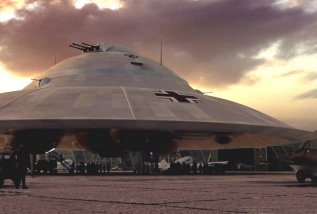
By 1939 the SS had produced the RFC-5, which it called the
Haunebu 1. In August 1939 the machine made its maiden flight and proved its
viability, being more than 65 foot in diameter and offering considerable storage
space. By the end of 1940 the RFC-2 (Haunebu II) had entered service as a
reconnaissance aircraft and there is certainly photographic evidence to support
this, for example an RFC-2 was photographed near Antarctica in 1940 (see next
chapter.) It should be noted that there is scant corroborative and historically
verifiable information to support these claims, however the design of the
Haunebu II should be noted for future reference. Check our more here.
Whatever their exact nature, it appears confirmed that a range
of alternative design aircraft were by now either on the drawing board, hovering
above the ground, or crashing into it. Some of these designs proved viable and
successes were being reported.
On 17th April 1945 Miethe was able to
advise Hitler that the V-7 had been tested in the skies above the Baltic. This
particular craft was a supersonic helicopter fitted with 12 BMW Turbo aggregate
engines. During its first test it reached an altitude of 78000feet and then
80000 feet on its second test.
Miethe reported that the new craft could be
powered by unconventional energy sources in principle. However these new
technologies were coming on-line too late, for the war was already being lost
and won.
Within months the Allies and Russians had poured into central Europe, Hitler
was dead and the war apparently over. And as soon as the war was over, ghost rockets started
appearing over Scandinavia and within two years ‘flying saucers’ were being
reported wholesale over mainland United States. It was no co-incidence.
After the end of the war in 1945, Russian and American
intelligence teams began a hunt to track down this perceived military and
scientific booty of the advanced German technology. Following the discovery of
particle/laser beam weaponry in German military bases, the US War Department
decided that the US must not only control this technology, but also the
scientists who had helped develop it "to ensure that [America] takes full
advantage of those significant developments which are deemed vital to our
national security." It therefore launched a project to bring these personnel to
the United States. Whilst initially publicised the nature, extent and secrecy of
the project, later termed ‘Operation Paperclip’ remained classified until
1973.
The thinking behind Paperclip was exemplified in a letter Major
General Hugh Knerr, Deputy Commanding General for Administration of US Strategic
Forces in Europe, wrote to Lieutenant General Carl Spatz in March 1945:
"Occupation of German scientific and industrial establishments has revealed the
fact that we have been alarmingly backward in many fields of research, if we do
not take this opportunity to seize apparatus and the brains that developed it
and put this combination back to work promptly, we will remain several years
behind while we attempt to cover a field already exploited."
There was however, one slight problem: It was illegal, for US
law explicitly prohibited Nazi officials from immigrating to America, and as
many as three-quarters of the scientists in question were allegedly committed
Nazis. (Indeed as at least 1600 scientists and their dependants were taken to
America under Operation Paperclip and its successor projects, it could hardly
avoid including Nazis.)
However President Truman (left) decided that the national
interest was paramount and that America needed the German scientists to work on
America’s behalf. In fairness to Truman, he expressly ordered that anyone found
to "have been a member of the Nazi party and more than a nominal participant in
its activities, or an active supporter of Nazism or militarism" must be excluded
from the operation.

Operation Paperclip was carried out by the Joint Intelligence
Objectives Agency (JIOA) and had two aims: Firstly, to exploit German Scientists
for American research by rounding up Nazi scientists and taking them to America.
and, secondly, to deny these intellectual resources to the Soviet Union (7).
(The name ‘Operation Paperclip’ derived from the fact that those individuals
selected to go to the United States were distinguished by paperclips on their
files joining their scientific papers with regular immigration forms.(8))
The Joint Intelligence Objectives Agency (JIOA) then conducted
background investigations on the identified scientists, and in February 1947 the
Director of the JIOA, Navy Captain Bosquet Wev, submitted the first set of
dossiers to the State and Justice Departments for review.
These dossiers, though, proved to be damning, with Samuel
Klaus, the State Department’s representative on the JOIA Board claiming that all
the scientists in the first batch were ‘ardent Nazis’. The visa requests were
consequently denied. (Wev already knew those proposed had Nazi backgrounds this
for in a memo dated 27th April 1948 to the Pentagon’s Director of Intelligence,
he wrote "Security investigations conducted by the military have disclosed the
fact that the majority of German scientists were members of either the Nazi
Party or one or more of its affiliates." (9)
Wev was furious and he fired off a memo to the State Department
in March 1948 warning that "the best interests of the United States have been
subjugated to the efforts expended in ‘beating a dead Nazi horse’" (10).
The following month, 27th April 1948, Wev again wrote to
his superiors concerned about the delays in approving the German scientists. He
stated "In light of the situation existing in Europe today, it is conceivable
that continued delay and opposition to the immigration of these scientists could
result in their eventually falling into then hands of the Russians who would
then gain the valuable information and ability possessed by these men. Such an
eventuality could have a most serious and adverse effect on the national
Security of the United States." (11)
By this time the Nazi Intelligence leader, Reinhard Gehlen had
met with the future CIA Director (26th February 1953 – 29th November 1961),
Allen Dulles (right), and they had hit it off. Gehlen was a master spy for the
Nazis and had infiltrated Russia with his vast intelligence network. (In 1942
the future CIA Director Dulles had moved to Bern, Switzerland, as Head of Office
of Strategic Services to negotiate with some Nazi leaders who were already
convinced they were going to lose WWII and wanted a deal with the US about a
possible future war with the USSR.) Dulles was not above pursuing his own agenda
with the Nazis, for he had worked with many of them before the war; as a
prominent New York lawyer (1926-1942 and again from 1946 to 1950).
When Gehlen
surrendered to the US, he was taken to Fort Hunt, Virginia, where he and the US
Army reached an agreement: his intelligence unit would work for and be funded by
the US until a new German Government came into power.
In the meantime,
should he find a conflict between the interests of Germany and the US, he could
consider German interests first (12).
For almost
ten years the ‘Gehlen Org’ as it became to be known, operated safely within the
CIA and was virtually the CIA’s only source of intelligence on Eastern Europe. Then in 1955 it evolved into the BND (the German equivalent of the CIA) and
continued to co-operate with its US counterparts. The scientists immigration problem was then side-stepped with
the dossiers being ‘cleansed’ of incriminating evidence and, as promised, Allen
Dulles delivered Gehlen Org, the Nazi Intelligence Unit, to the CIA, which later
opened many umbrella projects based on earlier Nazi research.
Operation Paperclip also had a part to play in events at Maury
Island. Washington State, itself, was the location of several aerospace defence
contractors, which were benefiting from the then secret Paperclip Operation. It was also the location of sightings in
1947 of a number of aircraft that looked suspiciously like some that had been
seen on Nazi drawing boards and in the skies above Europe towards the end of the
war.
The officers who attended the Maury Island incident, Davidson
and Brown belonged to G-2: It was G-2’s responsibility to ensure Operation
Paperclip was kept as a covert activity and provide the necessary security to
achieve this. Another function of G-2 was the surveillance of anyone whose
activities put Paperclip security at risk. That they were on their way to
Wright-Patterson AFB with the objects Crisman had given them, was entirely
logical – Wright Patterson (then Wright-Field) was the major research and
development centre where many of the Nazi scientists had been taken to continue
their work.
One of the most prominent of the Paperclip physicians was
Hubertus Strughold, later known as the ‘father of space medicine’ and after whom
the Aeromedical Library at the USAF School of Aerospace medicine was named in
1977. His April 1947 intelligence report stated "[H]is successful career under
Hitler would seem to indicate that he must be in full accord with Hitler."
However he was admitted under Operation Paperclip on the grounds that he was
"not an ardent Nazi." (13)
Other Nazis included Klaus Barbie, the so-called ‘Butcher of
Lyon’, Otto von Bolschwing, infamous for his holocaust activities and the SS
Colonel, Otto Skorzeny (14). However the cleansing of the files did not always
stand up to the scrutiny of time. In 1984, Arthur Rudolph, who, in 1969 had been
awarded NASA’s Distinguished Service Award, left the country rather than face
charges as a Nazi war criminal.
Another former alleged Nazi was Wernher Von Braun. Born on
23rd March 1912, von Braun became one of the world’s first and foremost rocket
engineers and a leading authority on space travel. Born the son of Prussian
aristocrats Baron Magnus and Baroness Emmy von Braun, the young Wernher (left)
read Hermann Oberth’s ‘By Rocket into Planetary Space’ (De Rakete zu den Planetenaumen),
and his new interest led him to later enrol at the Berlin Institute of
Technology in 1930.
In 1932 he received his bachelor’s degree in mechanical engineering and he
was then offered a grant to conduct and develop scientific investigations on
liquid-fuelled rocket engines (15). Von Braun’s rocket experiments were tested
at the Kummersdorf Proving Grounds, sixty miles south of Berlin, between 1932
and 1937.
Kummersdorf was the launch site of two German V-2 rockets in
1934 (16). After their launch, Braun started work on a jet-assisted take off
vehicle for heavy bombers and all-rocket fighters (17) however Kummersdorf was
too small for this task, and so von Braun relocated to Peenemunde on the Baltic
Coast where he became director from 1937-1945. This site was then equipped with
laboratories and industrial facilities to facilitate the development, production
and testing of the German V-1 (Vengeance Weapon 1) and V-2, (Vengeance Weapon 2)
rockets (18). It was this V-2 rocket that inflicted such heavy damage on England
during the war. Von Braun was not a reluctant Nazi. Indeed, "he joined the
National Socialist Aviation Corps, getting his pilot’s license in 1933, the DAF
trade organisation, a hunting organisation associated with the Nazis, the air
raid protection investigation, and the SS horseback riding school (19)." Von
Braun’s own admissions in US Army records further show that he was a former SS
Major who frequently visited the underground rocket factory where 25,000
prisoners from the concentration camp Dora had died. According to the former
executive producer of CNN’s investigative unit, Linda Hunt, von Braun attended a
meeting that discussed rounding up of citizens off the streets of France to be
taken to Dora.
As the war entered its dying throws in 1945, von Braun ordered two men to
find an abandoned mine in the Harz Mountains to hide data about the V-2s.
Several large boxes were then placed in a discovered cave and von Braun sent his
younger brother Magnus off on a bicycle he had borrowed from a local innkeeper
to look for Allies to whom they could surrender. Von Braun and his scientific
staff duly surrendered to the US Army whilst most of the production engineers
were taken prisoner by the Soviets (20).
After entering America as part of Project Paperclip, on a pay
of $6 a day plus lodging in a military installation, Braun worked on guided
missiles for the US Army. He returned to Bavaria in 1948 to marry his second
cousin and he later served as Technical Director then later Chief of the Guided
Missile Development Division of Redstone Arsenal from 1950 to 1956 whilst living
in Huntsville, Alabama (21). Von Braun was later appointed Director of
Development Operations Division of the Army Missile Agency, which developed the
Jupiter-C rocket that was to successfully launch the western’s hemisphere’s
first satellite, ‘Explorer-I’ on 31st January 1958, auguring the birth of the
American Space Programme (22).
Two years later von Braun and his team were transferred to
NASA’s Marshall Space Flight Centre where he served as Director from July 1960
to February 1970. During the 1950s and 60s he achieved an almost celebrity
status as one of Walt Disney’s experts on the ‘World of Tomorrow’. In 1970 he
became NASA’s associate administrator and without him, it is unlikely that the
organisation would ever have put man on the Moon.
Over a course of twenty years, von Braun received
approximately 25 honorary degrees and he accepted many other awards and medals,
presented to him from small cities, to NASA and even the President. (Right - Von
Braun with President Kennedy.)
His dossier was apparently rewritten so he didn’t appear an
enthusiastic (alleged) Nazi and he attempted to play down his real Nazi
involvement by claiming "In 1939 [sic] I was officially demanded to join the
National Socialist Party. At this time I was already Technical Director at
Peenemünde … The technical work had … attracted attention at higher and higher
levels. Thus, my refusal to join the party would have meant that I would have to
abandon the work of my life. My membership in the party did not include any
political activity (23)."
However, von Braun’s claim was simply untrue, for other
scientists successfully used an old rule of the Weimar Republic that was still
in use, forcing anyone in the military to abstain from political
affiliation.
Wernher von Braun’s mentor, Hermann Oberth also entered the
US after the war under Operation Paperclip. Born 25th June 1894 in
the Transylvanian town of Hermannstadt, Oberth (right with von Braun) is widely
recognised as the founding father of modern rocketry, having published the paper
in 1923 that was to so inspire von Braun, ‘Die Rakete zu den
Planetenraumen’ (By Rocket into Planetary Space.) This was followed by a
longer version (429 pages) in 1929 that was internationally regarded as a work
of tremendous scientific importance.
When in his thirties, Oberth took Wernher von Braun (who
affectionately referred to Oberth as his ‘teacher’) on as an assistant, and they
worked together at Peenemunde developing the V2 rocket. After entering the US at
the end of the war along with the remaining 100 V2 rockets and components,
Oberth again worked with Von Braun as the entire Peenemunde team was
re-assembled at the White Sands Proving Grounds.
Oberth and Von Braun continued
their work and it was a later development of the same V2 rocket which had
inflicted so much damage on Northern Europe that was eventually to propel the
first American into space in the Saturn V rocket. Oberth retired three years
after entering the US and returned to Germany where he headed us the Oberth
Commission for the German Government into the UFO phenomenon.
TAGS: UFOs of the Third Reich, Nazi UFOs of the Third Reich, UFOs of the Third Reich Allegations, Hannebu Flying Disk, Operation Paperclip, Nazi UFOs