|
References
(1) Andrus, Pearl, Somervell Sketches et
Al.' P26 Self-published 1975
(2) Langston, Wann Jr, Nonmammalian
Comanchean Tetrapods Geoscience and Man, Vol. 8, pp77-102.
(3) Andrus, Pearl, Somervell Sketches et
Al. P26 Self-published 1975
(4) Bergan, G and Pittman J, ed. Nearshore
Clastic Carbonate Facies and Dinosaur Trackways in the Glen Rose Formation
(Lower Cretaceous) of Central Texas. GSA Field Trip #8, the Dallas
Geological Society, Dallas, Texas, 1990.
(5) Burdick, Clifford C, When Giants Roamed
the Earth, Signs of the Times July 25 pp 6-9, 1950.
(6) Whitcomb, J and Morris H, The Genesis
Flood pp173-175, Baker Book House, Grand Rapids, MI 1961.
(7) Wilder-Smith, A. E. Man's Origin, Man's
Destiny pp293-298, Bethany Fellowship. 1975.
(8) Verrill A H, Old Civilisations in the New
World, New Home Library, New York, 1943
(9) Tomas, A, We are Not The First p.40
Souvenir Press, London 1971.
(10) Ibid.
(11) Noorbergen, R, Secrets of the Lost
Races pp43-44, New English Library, London, 1978.
(12) Scientific American, Vol. 7, p298, June 1851.<
(13) Report in Scientific American noted by Chris
Cooper in Inadmissible Evidence The Unexplained, issue 40 p795.
(14) Noorbergen, R, Secrets of the Lost
Races pp41-42, New English Library, London, 1978.
(15) Ibid p.42.
(16) Wiant, Harry V, Creation Research
Society Quarterly 13:74 1976 quoted in Corliss.
(17) Noorbergen, R, Secrets of the Lost
Races p.42, New English Library, London, 1978.
(18) David Brewster, 1844, Report of the
British Association Pt 2, 51 1844 quoted in William Corliss Ancient Man
A Handbook of Puzzling Artefacts p651-2
(19) Noorbergen, R, Secrets of the Lost
Races p.42, New English Library, London, 1978.
(20) Nature, London 1886 and L'Astronomie, Paris
1887 as reported in Noorbergen, R, Secrets Of the Lost Races.
(21) American Journal of science 1:2:144-6 1820,
quoted in William R Corliss Strange Artefacts Sourcebook Project.
(22) J B Browne, American Journal of Science
quoted in William R Corliss Ancient man, A Handbook of Puzzling Artefacts.
(23) Ibid
(24) Sinclair, W.J. Recent Investigations Bearing On The Question Of the Occurrence Of Neocene Man In The Auriferous
Gravels of Sierra Nevada pp117-118, University of California Publications
in American Archaeology and Ethnology 1908.
(25) Becker, G F Antiquities from under the
Tuolumne Table Mountain in California pp192-193 in 'Bulletin of the
Geographical Society of America' 1891.
(26) Review of the Evidence Relating to
Auriferous Gravel Man in California Papers One and Two published in
American Anthropologist Vol. 1 pp 107-121 and pp614-645, 1899.
(27) Sinclair, W. J., Recent Investigations
Bearing On The Question of the Occurrence of Neocene Man in the Auriferous
Gravels of Sierra Nevada pp. 107-131, University of California Publications
in American Archaeology and Ethnology, Vol. 7, No. 2, 1908.
(28) White, John, Pole Shift pp38-44, W
H Allen, London 1980.
(29) Hapgood, Charles, 'Maps of the Ancient Sea
Kings' p rev ed., Turnstone Press, London 1979.
(30) Ibid p226.
(31) Morris, J, Tracking Those Incredible
Dinosaurs p110-126, San Diego, California, 1980.
(32) Hastings, Ronnie J.,Creationist's "Glen
Rose Man" Proves to be a Fish Tooth (As Expected) NCSE Reports, Vol. 9., No
3 pp14-15 1987.
(33) Gorbovsky, A., Riddles of Ancient
History, Moscow 1966.
(34) Fate & Fortune pp38-40, Issue 2,
Marshall Cavendish Ltd., London 1974. |
 George Adams, the brother of 'Bull' Adams (left) who had made the original find, delivered another body blow. He had cashed in on the interest generated in the tracks by selling what were supposedly individual blocks with 'mantracks' on them. However, Adams later admitted that he had created these blocks himself. Adam's nephew Wayland once even told a group of creationist researchers how his uncle created the 'tracks'. He advised that his uncle would start with a suitably sized block already containing a depression (making the job easier), and then carve in the human features (31). Unfortunately Uncle George was a pretty poor carver and of the tracks he is known to have carved, all show serious anatomic errors, including misplaced ball and arch, and badly shapen toes. Dr. Don Patton, a latter-day proponent of the mantracks (below), then entered the dying controversy. One additional argument that had been proposed to discredit the mantrack claims was that no-man could possibly have a footprint 15" long. "Not so," Patton decreed noting that James Donaldson, a Dallas football player has a foot some 3 inches longer than the Burdick track, (supposedly making his foot over 18 inches long.)
 However, all such accounts of pre-historic artifacts should be treated with some caution, particularly as the actual artifacts themselves are rarely available for scientific inspection; the researcher has to rely on the reports of others and anecdotal evidence. Such dangers are readily evident in the 'discovery' of ancient electric disks high in the Tibetan Mountains. According to the German Review Das Vegetarishe Universum, a Chinese archaeologist Chi Pu Tei discovered a series of graves arranged in rows in caves in the Bayan Kara Uula Mountains on the Chinese-Tibet borders in 1938.
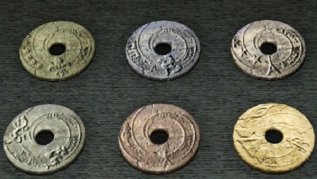 Information gleaned from the deciphered discs stated that a group of alien beings had crash-landed on Earth 12,000 years ago and had neither sufficient power to take off again nor the means to build an alternative craft. They tried to forge relationships with the local inhabitants, however these people proved hostile and some aliens were killed. The remaining visitors hid in the nearby caves. The few that survived left traces of their DNA in two of the local tribes, the 'Kam' and 'Dropa', tribes who are described as small and lightly built. This story appears intriguing, however what appears historic fact becomes decidedly fanciful when the author of the book where this account first surfaced is mentioned. Erich Von Daniken. Yes, the discs are there but little else is based on fact. Daniken quotes his source for this story as a conversation in Moscow in 1968 with Soviet writer Aleksandr Kazantsev and records that the discs themselves and the documentation of their discovery is preserved at the then Peking Academy of Prehistory and the Chinese Academy of Sciences at T'ai-Pei in Taiwan.