|
Towards The Sky
Synopsis: Sirius Mystery: A review of the origin of the Dogon tribe and Dogon legend together with Carl Sagan's hypothesis of contact with an advanced technological civilisation.
In a remote, rocky, desolate and acrid region of Western
Africa, a tribe called the Dogon scratch out a way of life that has changed
little over the centuries. With traditions firmly rooted in agriculture, western
technology has no place in their lives, although their philosophy and religion
is both rich and complex.
The exact origin of the Dogon tribe is lost in history,
however they are known to have settled in the Bandiagara Plateau, at the
Southern edge of the Sahara desert (where they remain today) some time between
the 13th and 16th centuries. They are originally believed
to have been of Egyptian descent. Today the tribe has a population of 600,000; 138,000 of whom
live in Burkina Faso, with the majority of 462,000 living in Mali itself.
The Dogon way of life is steeped in astronomical tradition
based on a knowledge kept by the tribe’s priests that dates back to 3200 BCE. It
is this knowledge that makes the tribe so remarkable, for they appear to know
facts not supposedly known to man until the twentieth century.
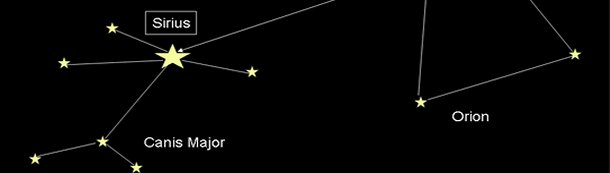
The Dogon have long held that the star Sirius, some 8.7 light years away, has a
companion star which is invisible to the human eye.
They state that this companion star, which rotates on its axis, has a
50-year elliptical orbit around the visible Sirius and is extremely heavy. They also have knowledge
of the rings of Saturn, Jupiter’s satellites and other detailed astronomical
data some, of which, it has to be acknowledged is inaccurate.
This knowledge was first recorded by two French
anthropologists, Marcel Griaule and Germain Dieterlen following
discussions with four Dogon priests in the 1930s. Perhaps none of this seems
remarkable, however Sirius B was only seen for the first time by telescope
in 1970 when photographed by Irving Lindenblad of the US Naval Observatory. Yet
the Dogon had apparently known about this second star for millennia.
|
|
 The renowned astronomer, Carl Sagan concluded that the Dogon
could not have acquired their knowledge without contact with an advanced
technological civilisation. He suggested, however, that the civilisation was
terrestrial rather than extraterrestrial in origin (1).

Sagan believed that the Dogon gained their knowledge from western
travellers who visited the tribes during the 1920 and 1930s. His view is that
these travellers would have discussed astronomy with the Dogon priests who would
then have weaved this new information into older traditions, which in turn,
mislead the anthropologists. However, this is purely conjecture, accurate though
it may be.
It is true, however, that there have been French schools in
that area teaching geography and natural history in their curriculum since 1907
(the Republic of Mali was formerly known as French Sudan). It has also been
noted that there has been a nearby Muslim University at Timbuktu since the
16th century and evidence that some members of the Dogon fought side
by side with the French during the First World War (2). Could these have been
the sources of the Dogon knowledge?
|
Robert Temple, author of ‘The Sirius Mystery’ thinks
not. "The two French anthropologists [Griaule and Dieterlen] started their work
in 1931, and they are positive that the Dogon knew details about Sirius B when
they arrived …Eddington revealed the superdensity of Sirius B around 1926 … so
there is a narrow period …when one has to imagine some group of amateur Western
astronomers rushing out to … Mali and implanting this knowledge in the
presumably pliant minds of the Dogon."(3)
The Dogon account for their ‘forbidden’ knowledge, however, appears
equally unlikely. They claim that a people from the Sirius system called the
‘Nommo’ visited Earth thousands of years ago. Check out more here. The Nommos were described as ugly, amphibious creatures that
resembled mermen and mermaids (right). (Incidentally, it should be remembered that
humans and other mammals originally evolved from amphibians.)
According to Dogon legend, the Nommos lived on a planet that
orbits another star in the Sirius system. They landed on Earth in an ‘ark’ that
made a spinning descent to the ground with great noise and wind. Temple gives
the following account of this event. "The [Dogon] descriptions of the landing of
the ark are extremely precise. The ark is said to have landed on the earth to
the north-east of the Dogon country, which is where the Dogon claim to have come
from originally.
"The Dogon describe the sound of the landing of the ark.
They say the ‘word’ of the Nommo was cast down by him in the four directions as
he descended, and it sounded like the echoing of the four large stone blocks
being struck with stones by the children, according to special rhythms, in a
very small cave near Lake Debo.
Presumably a thunderous vibrating sound is what
the Dogon are trying to convey. One can imagine standing in the cave and holding
one’s ears at the noise. The descent of the ark must have sounded like a jet
runway at close range." (4) The Dogon claim that not only did the Nommos give them
knowledge about Sirius B, they also advised that Jupiter has four major moons,
that Saturn has rings, and that the planets orbit the Sun. Much of this
knowledge was not accepted or known until recent centuries.
These, then, are the two known accounts of how the Dogon
received their knowledge of Sirius B Whilst Sagan’s
theory has more immediate appeal, it does not account for a 400 year old Dogon
artefact that apparently depicts the Sirius configuration, nor the ceremonies
held by the Dogon that can be traced back to at least the 13th
Century to celebrate the cycle of Sirius A and B, nor how they knew about the
super density of Sirius B, a fact only discovered a few years before the
anthropologists recorded the Dogon story.
|
These facts are enshrined in ancient Dogon rituals, portrayed
in sand drawings, built into their sacred architecture and can be seen in
carvings and patterns dating back hundreds if not thousands of years. So, how can this knowledge be accounted for? It certainly
predates the modern ‘discovery’ of Sirius B by hundreds of years and therefore
any talk of westerners contaminating the Dogon traditions becomes
irrelevant.
Yet it is unlikely that if the Dogon had had early contact with
an extraterrestrial race that this would have happened in isolation. We know
that the Dogon originated elsewhere in Africa spreading out to Mali by the
13th to 16th centuries. There should therefore be evidence
of this contact, if it did happen, in the traditions of other related cultures.
And there is, for the creatures described by the Dogon
also feature in Babylonian, Greek and Sumerian mythology.
From Berossus, a Babylonian priest, there is a description of
creatures known as the ‘Annedoti’, the ‘Repulsive Ones’. These Annedoti
were fishmen who introduced civilisation. The first and most famous of these was
called ‘Oannes’ or ‘Oe’, who instructed the Babylonians "in
everything which could tend to soften manners and humanise mankind" (5).
Fishbodied aliens are also featured in Greek mythology, notably
in the island of Rhodes, with its culture-bearing gods, the
‘Telchines’. (Above, the hounds of Actaeon. According to legend,
these were the survivors of the Telchines.) Diodorus Siculus, the Greek
historian, wrote that they were "the discoverers of certain arts and introduced
other things which are useful for the life of mankind." (6). Other texts speak
of them being "submarine magic spirits". They had "dog’s heads and flippers for
hands" (7). The Philistines also worshipped "Dagon and Atargis"; two amphibian
deities who had human bodies but the tails of fish.
There is also some evidence to tie the Dogon claims into
Egyptian mythology. The Egyptian dog god Anubis is often identified with
Osiris, companion of the goddess Isis. Temple concludes that as Isis herself was
identified with Sirius, it is reasonable to suppose that her companion was
identified with the companion of Sirius, suggesting that the Egyptians knew of
the existence of Sirius B.
Temple realised the implications of his work: "When I started
writing this book [The Sirius Mystery] in earnest in 1967, the entire question
was framed in terms of an African tribe called the Dogon … the result in 1974 is
that I have been able to show that the information which the Dogon possess is
really more than 5000 years old and was possessed by the Ancient Egyptians in
the pre-dynastic times before 3200BC." (8)
|
It is this Egyptian connection that is so intriguing. We have
already seen that from no-where, the Egyptians suddenly formed a technologically
proficient society with astronomical, mathematical and other knowledge that
should have been unknown to them. Could the basis of Von Daniken’s claims (as
opposed to the evidence he draws on to support them) be accurate?
There is one piece of scientific fact that could prove or
disprove the claims once and for all, for the Dogon speak of a third star,
Sirius C, around which the Nommos’ planet revolves. If the existence of this
star is verified then, the rest of the Dogon claims would have to be taken as
probable fact. And it was. In 1995.
So what we have is a wealth of information regarding
possible extraterrestrial contacts with the planet Earth, and when put together
with the Dogon claims, the puzzles over forbidden knowledge, and pictorial
evidence, a convincing case appears to emerge.
It is all too easy to assume that the extraterrestrial
phenomenon is a product of a latter-day television age and gullibility. Yet
sightings of mysterious objects in the sky go back into the depths of history. Of course the further one goes back, the more fact, myth,
culture and religious illustration become blurred, however there are some
‘facts’ that defy reasonable explanation.
One of the earliest possible ‘records’ of extraterrestrial
contact was discovered by Tschi Pen Loa formerly of the University of Peking. He
found drawings some 47,000 years old on a Hunan Mountain and on an island in
Lake Tungting. These granite pictures showed people with large trunks and
cylindrical objects in the sky on which similar figures are seen standing
(9).
However probably the earliest authenticated report of a UFO can
be found in an ancient Indian text called the Samarangana-Sartradhara
that dates back to at least 500BCE. In one passage of this text, there is a
description of curious machines called ‘vimanas’, which can fly and be
controlled by pilots. The same devices are described in the Hindu epics
Mahabharata and Ramayana as military machines with the capability of carrying
‘death’ to anywhere in the world.
Roman writers make reference to strange sights in the sky.
Livy (59 BCE-AD 17) described a ‘sighting’ in 214 BCE at Hadria in Italy that
looked like an alter in the sky. Pliny the Elder (AD23-79) refers to ‘gleaming
beams in the sky’ in his De Rerum Naturae, which describes how, in 66BCE,
a ‘spark’ fell from a star to the Earth, became as large as the Moon, and then,
shrinking in size returned to the sky.
Inevitably we can only speculate as to what was seen. Others
who believe in ancient contact have presented cave and rock paintings in support
of their arguments.
|
 Such pictures have been quickly dismissed by others who
claim that they are merely pictures of hunters wearing ceremonial head-dresses
or masks as a ritual part of their culture. Whilst this may be an acceptable
explanation, it does not account for the similarity of pictures from cultures on
opposite sides of the oceans thousands of years ago.
For example, the above
picture (far left) is from a pre-historic rock carving near Capo di Ponte in Italy,
whilst the picture (above - left) is from the Toro Muerte Desert in Peru, on the
other side of the Atlantic Ocean, yet the headgear drawn is almost
identical.
Of course, too much can be read into a couple of primitive
pictures, if that’s all that existed, but it in fact there are other strange
representations noted in pictures and images throughout the world. For example,
this ancient aboriginal cave drawing (above) from 5000 years ago appears to show
strange beings with non-human features.
In 1961, the Russian astronomer Alexander Kazantsev brought
to the attention of the readers of the then Soviet magazine ‘Smena’ a
discovery made by Henri Labote in the Tassili plateau in the Sahara desert.
Labote had found sculpted rocks showing figures with strange rounded heads and
other mysterious scenes. These sculptures have been dated to circa. 6000BCE
(10).
These images are all the more remarkable because of their
similarity to the costumes worn in rituals of the Kayapo Indians of Brazil, a
tribe that has existed for at least 4000 years. This tribe’s rituals commemorate
Gods descending from the heavens bringing with them advanced knowledge and
skills.
 The ceremonial costume shown here (left) represents such a
‘Teacher from Heaven’. Its resemblance to a modern day astronaut’s suit is
remarkable. Similarly this 3000-year-old statue (right) found on the Equador-Bolivian border also appears to represent a humanoid in a space
suit.
Yet caution has to
be advised when considering these ancient images for we can only cast modern day
man’s eyes over them and offer a modern interpretation of what our ancestor’s
were attempting to record.
For some of the
images, however, our knowledge of past cultures can offer a better insight into
what the artists are trying to portray. For example, at first glance, the
Egyptian mural (below) appears to show in the upper left-hand area a helicopter,
with the upper right image appearing to be a boat or even a submarine. The image
below that resembles an airplane (or even a UFO) and the bottom image could be
taken as a jet-plane.
Yet, in fact, the hieroglyphs are not a record of ancient
knowledge of machines similar to modern technology, but merely a co-incidental
combination of quite common ancient Egyptian symbols. Check it out for yourself
here.
Again this
Japanese Dogu sculpture has been proposed by some as the
representation of a ‘space-visitor’. This 5000-year-old artefact shows a figure wearing what appears
to be a helmet, and even goggles that should not have existed in that period of
history. However, although looking bizarre and out of place, the
sculpture can hardly be deemed proof of extraterrestrial contact.
Nevertheless some of the ancient images are quite intriguing.
Whilst this Neolithic cave painting from circa 3000BCE from
south-west France seems to depict a landscape rich in wildlife but with strange
circular discs dotted around the image, other ancient pictures appear to be much
more explicit.
Take for example this cave painting from circa 2000BCE
found on the Russian-Chinese border. It could of course be argued that our
modern eyes can only interpret pictures in certain ways, however (and perhaps
falling into this trap) it appears that the figure closest to the viewer is
clutching some form of dial, the furthest away individual has a helmet on with
antenna, and what appears to be a UFO under some form of propulsion hovering
above them both. Few of the features in this picture appear compatible with
images that should have formed the everyday world of ancient man.
The above picture appears all the more convincing when compared
with the plate (below) which appears to show a type of alien known as a ‘Grey’
and a ‘UFO’. This plate is thousands of years old, however the idea of ‘Greys’
is supposedly a totally modern concept, first featured in Hollywood
blockbusters.
It will be remembered that other images of UFOs and alien type
figures and astronauts also featured on the stones at Ica, whose origins are
lost in the depths of time. One of the earliest ‘UFO’ reports came from Ancient Egypt.
Writer Brinsley Le Poer Trench (right) quotes in his book ‘Sky People’
from a papyrus found amongst the papers of Professor Alberto Tulli, former
director of the Egyptian museum at the Vatican. The papyrus was from the
original annals of Pharaoh Thutmose III (d.1436BCE), the grandfather of the
intrepid Thutmose IV who had investigated the pyramids. Unfortunately it was
badly damaged with many of the hieroglyphics being unreadable. Despite this
Prince Boris de Rachewiltz was still able to offer a translation:
"In the year 22, of the third month of winter, sixth hour of
the day … the scribes of the House of Life found it was a circle of fire that
was coming in the sky … it had no head, the breath of its mouth had a foul
odour. Its body one rod long and one rod wide. It had no voice. Their hearts
became confused through it: then they laid themselves on their bellies … they
went to the Pharaoh … to report it.
"His majesty ordered … has been examined … as to all which is
written in the papyrus rolls of the House of Life. His majesty was meditating on
what had happened. Now after some days had passed, these things became more
numerous in the sky than ever. They shone more in the sky than the brightness of
the sun, and extended to the limits of the four supports of the heavens …
Powerful was the position of the fire circles. The army of the Pharaoh looked on
him in their midst. It was after supper. Thereupon, these fire circles ascended
higher in the sky towards the south…" (11)
TAGS: Sirius Mystery, Origin of Dogon Tribe, Dogon Tribe, Dogon Legend, Carl Sagan, Contact with an Advanced Technological Civilisation 
|