|
Space Anomalies Part III Synopsis: Apollo Missions and UFOs: A review of the NASA Apollo space missions detailing possible UFO encounters and other anomalous phenomena in space.
This Apollo 17 (7th-19th December 1972) sighting was detailed
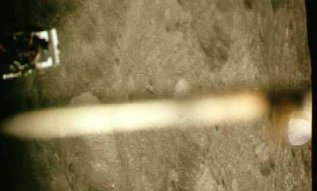
as follows: Command Module: What are you learning? Ground Control: Hot spots on the Moon, Jack. Command Module: Where are your big anomalies? Can you summarise quickly? Ground Control: Jack, we’ll get that for you on the next pass. Command Module: Hey, I can see a bright spot down there on the landing site where they must have blown off some of that halo stuff.Ground Control: Roger. Interesting. Very … go to KILO KILO. Command Module: Hey, its grey now and the number one extends … Ground Control: Roger. We got it. And we copy that’s its all the way down there. Go to KILO KILO on that. Command Module: Mode is going to HM. Recorder is off. Lose a little communication there, huh? Okay, there’s Bravo, Bravo, select OMNI. Hey, you know, you’ll never believe it. I’m right over the edge of the Orientale. I just looked down and saw the light flash again. Ground Control: Roger. Understand. Command Module: Right at the end of the rille. Ground Control: Any chance of … ? Command Module: That’s on the east of the Orientale. Ground Control: You don’t suppose it could be a Vostock? [A Russian space probe.] Command Module: I’ll be damned. I’ve got to mark that spot on the map. (24) Where the flashing light came from has never been disclosed, if any answer was ever found. The idea that the flashing light could have been from a Vostock is bizarre. The Vostock was an obsolete Russian space probe that couldn’t even reach the Moon, let alone perch on the edge of a crater flashing its lights. The flashing lights continued to be a mystery during this mission as this later transcript testifies:
Capcom: Okay, I copy on that Jack. And as long as we’re talking about Grimaldi, we’d like to have you brief Rob exactly on the location of that flashing light you saw … We’ll probably ask him to take a picture of it. Maybe during one of his solo periods (25). The Americans have made not all sightings on anomalies. The following was reported by cosmonauts from Salut 6 and Soyuz 9 during a mission when they orbited the Earth together between June and November 1978: "Can you describe its shape?" "A ball. Like a tennis ball, at first. Then it grew larger." (26)
Lazarevich: Tell me, what are the most interesting natural phenomena you see on Earth? Manakov: Yesterday, for example, I saw – if one may call it that – an unidentified flying object. I called it that. Lazarevich: What was it? Manakov: Well, I don’t know. It was a great, silvery sphere, it was iridescent … this was at 22.50hrs. Lazarevich: This was over the region of Newfoundland? Manakov: No, we had already passed over Newfoundland. There was an absolutely clean, clear sky. It is difficult to determine, but the object was at great altitude over the earth - perhaps 20-30 kilometres. It was much larger than a huge ship. Lazarevich: Could it have been an iceberg? Manakov: No. This object had a regular shape, but what is was I don’t know. Perhaps an enormous, experimental sphere, or something else ... I was observing it for about six or seven seconds, then it disappeared. Lazarevich: But is it possible to determine approximately its speed? Manakov: It simply was hovering over the earth… (27) There have been many other reports of anomalous phenomena in space. In 1973 a photograph was taken by Owen K. Garriot from the American space station, Skylab (Skylab SL-3 28th July 1973 – 25th September 1973). The photograph showed an object (left) that rotated for several minutes before disappearing. (Inset: light enhanced version of this picture.)
An insight into the nature of these strange objects may be gleaned from an episode that occurred on 15th September 1991, when the space shuttle Discovery (below) was orbiting the Earth during NASA Mission STS-48. Whilst above Indonesia, one of Discovery’s cameras filmed several anomalous objects (left). NASA examined the film and advised that the objects were in fact just ice particles, killing off the furry of interest that had been generated.
Kasher’s background was impressive, having actually worked for NASA and for the Star Wars Programme before becoming a Professor in Physics and Astronomy at the University of Nebraska. His research into the film led him to conclude that the ice particle theory was "a completely untenable position." He stated that, in his opinion, the objects observed on the film were manoeuvring in a manner compatible with being intelligently controlled (29). Check out the footage for yourself here. Kasher based this conclusion on an analysis of the NASA footage frame by frame. He was able to demonstrate that the objects’ positions, directions, speeds and capacity for acceleration were incompatible with NASA’s ice-particle theory and he provided five ‘proofs’ to support his findings. (See Appendix 1). Having ruled out that the objects could be ice-particles, Kasher added, "we can [also] rule out more mundane things like comets, space junk and satellites. They just simply don’t change direction like that, and that really leaves only one other possibility … that these objects were spacecraft." (30) More insidiously, the original NASA footage appears to show a ground based missile firing at the objects. This last piece of information, is of particular interest for, according to a report in the UK’s Mail On Sunday, NASA has deployed a new ‘beam’ weapon which is apparently designed to ‘zap’ space-junk. This weapon, which NASA refers to as a ‘ray gun’ is at present targeted on the construction of the international space station, high above the Earth. NASA claims that the gun is there to protect both the astronauts and the station from being bombarded with "thousands of pieces of space debris", ranging from screwdrivers dropped by astronauts to small meteorites. NASA has denied that the gun has been deployed as a precaution against ‘attack’ (31). Similar events were evident in the December 1996 mission of the space shuttle Columbia (STS-80). Shortly after touchdown, rumours began circulating that objects had been observed on the NASA TV downlink during the flight. The objects were apparently similar, if not the same to those that had been observed on the STS-48 mission and researched by Jack Kasher. Video footage from this mission shows Columbia 220 miles above the Earth on 1st December 1996. As the craft traverses Indonesia, lightening can be seen between the clouds and a number of anomalous objects can be seen coming out from the clouds and into space.
(C) VIOLATIONS 1999 - 2009 References (1) Levy, Paul F ‘Ex-Astronaut: Why I Believe There’s Intelligent Life In Space’ 23.10.79 (2) Saga’s UFO Special III P58. (3) Condon P19 (4) Beckley, Timothy Green, ‘MJ-12 and the Riddle of Hangar 18’ pp13-14, Inner Light Publications, New Brunswick, New Jersey 1989. (5) Video Recording made in 1994 by Michael Hesemann, ETCON, Worringer Strasse 1, D-4000, Dusseldorf 1, Germany reproduced in ‘Beyond Top Secret’ Good, Timothy P449. (6) Wilson, Don ‘Our Mysterious Spaceship Moon’, P29, Sphere, 1976. (7) Ibid p 29 (8) Ibid pp29-30 (9) The Condon Report: Scientific Study of Unidentified Flying Objects. p.205 New York, Bantam 1969 (10) Ibid pp204-205 (11) Ibid p208 (12) Ibid p207-8 (13) Ibid pp207-8 (14) Wilson, Don ‘Our Mysterious Spaceship Moon’, P36, Sphere, 1976. (15) Saga’s UFO Special III P46 (16) Ibid. (17) Wilson, Don ‘Our Mysterious Spaceship Moon’, P45, Sphere, 1976. (18) Ibid. p.50 (19) Ibid pp50-51 (20) Ibid p52 (21) Ibid pp52-53 (22) Ibid p54 (23) Saga, March 1974 p46. (24) Wilson, Don ‘Our Mysterious Spaceship Moon’, pp58-59, Sphere, 1976. (25) Ibid p60 (26) UFO Files Vol. I (27) Reproduced in UFO report 1992 by Timothy Good, Sidgwick and Jackson. (28) Aviation Week and Space Technology, 3rd February 1997, P68. (29) Kasher PhD, Jack ‘NASA UFO’ Video, Empire Entertainments, 1996 (30) Ibid (31) The Mail on Sunday, 26th January 1997.
Kasher's 'Proofs' The following ‘proofs’ are used as evidence by Jack Kasher, PhD that the objects observed in the NASA footage are not ice-particles, but are intelligently controlled craft: i) The main object at the beginning of the flash [see on the film footage] waits one half-second before it accelerates. Moreover, the force that stops the main object is directed towards the shuttle from outer space. ii) The lines of motion of the two main objects, when traced back, do not meet at a point, which would be the location of the attitude adjuster rocket. iii) The rocket exhaust velocity as calculated from the distance and time to reach the main object would be almost 130 feet/second. The actual exhaust velocity is about 8450 feet/second. iv) The final velocity of the main object should be about 98% of the actual exhaust velocity, or about 8300 feet/second. Instead it would be 5.5 feet/second if its velocity vector is to point back to the Vernier rocket. These numbers do not fit with the 130 feet/second. v) For the main object to have a velocity of 8300 feet/second it would have to be more than 22 miles from the shuttle. In addition the adjuster rocket would have to be nearly 15 miles from the shuttle.
|

Russian journalist Leonid Lazarevich interviewed cosmonauts Manakov
and Strekalov on 28th September 1990 when they were aboard the space station
Mir. The interview was published in ‘Robochaya Tribuna’ and soviet youth
magazines:
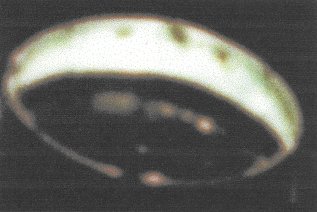
Then on 6th January 1997, the Solar and Heliostropic
Observatory (SOHO), a joint NASA/ESA satellite stationed in orbit 600,000 miles
from Earth, is reported to have photographed a "very bright lozenge shaped
object" above the sun. The photograph was subsequently published in Aviation
Week and Space Technology. Neither NASA nor ESA have commented on it (28).
"There is one predominate object as others appear and go
everywhere. Objects cruising below the clouds, rising up from the clouds,
spheres of light changing shape and colour, ‘streaks’ or ‘rods’ of light
cruising very closely by the camera. UFOs travelling thousands of mph in orbit,
objects entering the Earth's atmosphere from space. The main one becomes a large
white sphere, doubling in size.