Synopsis: Egyptian Mysteries: A review of Ancient Egyptian mysteries including who constructed the Great Pyramid and other secrets on the Giza Plateau.
Since the time of the classical Greeks people have gazed at the
Great Pyramid, the sole survivor of the ancient world’s seven wonders, and
wondered about it’s mysterious past.
Apparently built on the edge of known history, unanswered
questions have been asked about who built it, and how could man, in antiquity,
have the skills for its construction. We are told the pyramid was built as a
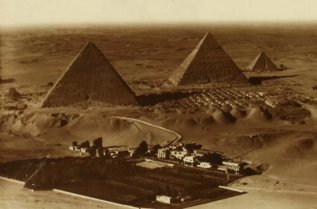
tomb for Chephren around 2575 years BCE. Situated ten miles west of Cairo, the
pyramid covers a ground area of 13.1 acres and was built with over 2.3 million
limestone blocks each averaging two and a half tons each. Some idea of the
enormity of the structure is revealed when it is noted that the pyramid contains
enough stone to build a wall of foot-square cubes, two thirds around the Earth
at its equator – some 16,600 miles.
We know those who constructed the Great Pyramid were competent
builders and mathematicians for the structure is aligned to the cardinal compass
points to within one twelfth of a degree and the thirteen acre base area is
level to within a fraction of an inch. The pyramid also lies on the longest
land-contact meridian on the Earth’s surface and at the geographical centre of
Earth’s land mass, including the then supposedly unknown Americas and
Antarctica.
The design also appears to have incorporated
advanced mathematical and astronomical knowledge far in advance of that
belonging to any known civilisation. The four slightly hollow faces climb to an
angle of 51º 51’ 14.3" to a summit platform. The apex is missing, however by projection
to the theoretical apex; the angle of slope gives a relationship of the
pyramid’s height to the perimeter of is designed base equal to the radius of a
circle to its circumference. In case you didn’t follow that, if you divide the
distance around the base of the pyramid by its height, the product is a
measurement that should not have been known to ancient man.
There are other mathematical marvels. Of several units of
measurement, the Sacred Cubit (25.0265 inches, one ten-millionth of the
mean polar radius of the Earth as determined during the International
Geophysical Year 1957-8) is found in multiples establishing the pyramid as a
textbook of geophysical and astronomical data. The side of the designed base
square measures 365.242 Sacred Cubits – the exact number of days in the solar
year. Other measurements derived from the ‘hollowing-in’ of the sides as
established in the 1920s by Leeds engineer David Davidson accurately represent
sidereal (365.256) and anomalistic (365.259) years. The pyramid or
primitive inch (1.00106 inches: 1/25th of the Sacred
Cubit)is also implicated in the repetition of specific values.
Measurements of exactly 365.242"P are found in the King’s Chamber complex. Check
out more here.
Whatever its past, the Great Pyramid kept it secrets on the
great Giza Plateau for millennia until the ninth-Century Arab Caliph, Abdullah
Al Mamum undertook to investigate it after he had heard that the pyramid
contained secret chambers full of highly accurate ancient maps of the world and
other astronomical charts and tables. Check out this 3D computer simulation of
the inside of the great pyramid here.
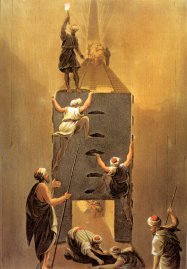
With a team of architects, builders and stonemasons, the Caliph set
off in the year now known to Westerners as AD820 to enter the giant structure
for the first in thousands of years. It soon became obvious why they were in
fact the first adventurers up to that time to enter the pyramid, for they were
unable to find an entrance to the structure. Eventually they hit upon the idea
of heating the limestone blocks then dowsing them in cold vinegar until they
cracked. Using this painfully slow method they managed to burrow through 100
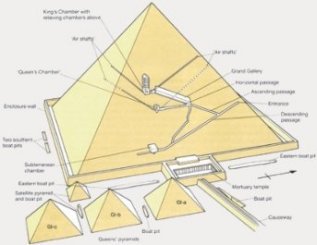
feet of solid rock until reaching a narrow, four-foot high passage that climbed
steeply upwards.
At the top end of this passageway they discovered the pyramid’s
original entrance, forty-nine feet above the ground. They then followed the
passageway downwards. Eventually after a slow descent into the unknown, they
found a chamber. An empty chamber.
The men explored around in the eerie darkness; convinced that
there must be other chambers or passageway - for surely the structure had not
been built only to leave it empty?
Sometime later, Al Mamun’s men returned with news. They had
discovered what appeared to be another corridor, this time sloping upwards.
However, if it was a corridor, possibly leading to a room full of lost knowledge
and riches, then its mystery was to remain, for the corridor was blocked by a
gigantic granite plug, barring them from proceeding further.
The men then attacked the granite with hammer and chisels,
however the block proved to be too strong. Disillusioned and frustrated they
rested, before realising that if they could not the plug hack through the
plug, then maybe they could chisel around it. And they did. And they
found another plug. So they did the same thing again. And they found another
plug. And then another.

Eventually they emerged exhausted into a low-ceilinged corridor
that slanted upwards until it intersected with a level passageway. The men hoped
that after all their efforts this passageway would lead them to their destiny –
a hidden chamber full of lost knowledge and perhaps those craved for riches. The
passageway did lead to a chamber, but this chamber (later named the Queen’s
chamber) was also empty. The explorers were perplexed. Why go to all this
trouble to house seemingly nothing? They continued to believe that somewhere in
this giant structure, something must be hidden or buried and they were
determined to find it.
The search continued with this time an increasing sense of
excitement, for the explorers then discovered a corridor with walls of polished
limestone twenty-eight feet high. They named this area the Great Gallery. It is
easy to understand a feeling of mounting tension as they climbed a further 156
feet into the unknown before they discovered a vast chamber, thirty-four feet
long, seventeen feet wide and nineteen feet high. They named this the King’s
chamber.
This chamber, lost for so many centuries, slowly began to reveal its
secrets as the light of the men’s torches cast a yellow glow on its walls. But
far from being filled with great riches, the room appeared empty. But then,
there, at the far wall, they could see a sarcophagus. A sarcophagus so large
that the room was clearly built around it, and if the room, then perhaps the
pyramid itself. The men moved tentatively forward and looked inside.
Nothing. No body and certainly no treasure. In a fury the
explorers hacked into the floors and walls determined to find some recompense
for their endeavours, but there was nothing; not only no treasure nor knowledge,
but mysteriously, no sign whatsoever that the room had ever been entered before
their visit, for they were clearly the first to get by the huge stone plugs in
the passageway, and there was no other apparent way in.
The men left the pyramid perplexed, mystified and dejected.
Clearly some people had gone to extraordinary lengths to build this complex and
intriguing structure, with its shafts, blocks and chambers, yet there was
apparently not a single clue as to why they had done so; not a name, body,
writing or even a single hieroglyph etched on a wall to hint at the pyramid’s
purpose or function. Recreate their journey inside the Great Pyramid with this
video here.
Following this first known foray, little is known of pyramid
exploration until 1638 when a British mathematician, John Greaves visited Egypt.
His contribution to the Great Pyramid enigma was the discovery of a narrow well
that descended vertically from the bottom of the Grand Gallery. He concluded
that this was probably an escape route for the builders after they had set in
place the granite plugs that had caused Al Mamum so much frustration.
Unfortunately Greaves’ planned reconnaissance of the tunnel came to an abrupt
end after only sixty feet; not because of any blockage or other secret, but
because of the numbers of bats and the stench of their foul air.
Over the following centuries thousands visited the pyramids,
curious and eager to seek out its secrets. Without realising it, each and every
one of those visitors contributed to the eventual discovery of another puzzle
that continues to intrigue researchers: for each visitor left behind small
traces of water vapour from breath and perspiration. The cumulative effect of
these deposits over the centuries literally made the inside of the pyramid start
dissolving. As the build-up continued, it became inevitable that unless
something was done the structure itself would become unsafe. The task of finding
a solution to this problem was given to the German Archaeological Institute.
The Institute appointed an engineer, Rudolf Gantenbrink (left), as a
consultant to work on the problem. Gantenbrink’s experience of robotics in both
nuclear plants and undersea exploration, coupled with his amateur fascination
with the pyramids made him an ideal choice for the job. He recognised that the
solution to the immediate problem of humidity was to increase the airflow
throughout the pyramid. As it was already known that the pyramid had a series of
ducts throughout, Gantenbrink set about designing a robot that could travel up
and down these ducts to make an evaluation of their condition from the inside.
This would then inform what work would be required to clear the shafts from
centuries of debris.
The robot explorer he
invented he named ‘Upuaut’, an ancient Egyptian word for ‘Opener of the
Way’, and on completion of its work, heavy-duty fans were fitted to the
ducts to blast fresh air into the pyramid thereby solving the water vapour
problem.
Following on from the success of Upuaut, Gantenbrink went on to
design ‘Upuaut 2’ (right, a modified version of the original robot with its own
traction system that would allow it to climb up and down the shafts unaided. Upuaut 2 also had headlights; a laser guidance system and a small video camera
to send back pictures to a monitoring console. In due course the robot was
lowered into the shafts to start its work.
Gantenbrink later sent a video of the second machine’s journey
to Robert Bauval, an author and long time investigator of the pyramids. Bauval
takes up the story:
"I quickly put the [video] tape in and watched as the robot
appeared outside the Great Pyramid. Rudolf [Gantenbrink] put the robot into the
opening of the southern shaft in the Queen’s Chamber and then guided it with the
controls on a worktop inside the chamber. The robot began filming inside the
shaft. Slowly and laboriously it climbed, going upwards for about sixty-five
meters before coming to a stop. In front of it, clearly visible, was what looked
like a miniature portcullis slab, of the sort used by the Egyptians to seal off
a burial chamber.
Attached to the slab, or sliding door, were two copper
fittings, one of which was broken, a fragment of it lying on the floor of the
shaft. This last part of the shaft was lined with polished Tura limestone, which
as far as we know was used inside the pyramids only for lining chambers and was
considered sacred by the pyramid builders. It could also be seen from the
movement of the robot’s laser beam that the slab at the end of the shaft was not
fully in contact with the floor, but left a gap of about half a centimetre;
there was a triangular chip removed from one corner, providing a tantalising
glimpse of a grooved channel and a dark recess beyond. Though not conclusive, the video evidence
was that what we were looking at was a hatchway leading, perhaps, to some hidden
chamber." (24)
The door was discovered on 22nd March 1993
[NOTE the following was written before a recent drilling
through the door which revealed yet another door further up the passage]
yet
no further exploration of what may lie behind the door has been undertaken;
indeed a week after the discovery Gantenbrink was told to pack up his robot and
leave the site. The German Archaeological Institute denied there was anything
mysterious about this. "The project was finished. The shafts had been explored
and there was nothing further to do. The blocking stone that was found at the
end of the shaft is very normal. All these shafts were originally blocked. It is
the normal construction. It is not possible to open the blocking; the Egyptians
would never allow it." (25)
Gantenbrink however did not agree and applied an engineer’s
perspective to the issue, citing the polished limestone noted by Bauval around
the area of the door. This stone is found nowhere else in the 180 meters of
shafts explored to date and suggested an upgrading to something grander, rather
than abandonment of the shaft as Egyptologists propose. Gantenbrink also noted
evidence of structural damage around the doorway (found no where else in any of
the shafts) indicative of internal stress in the area, suggestive of a cavity,
and this idea is supported by the stress relieving construction techniques
deployed around the door; blocks laid vertically rather than horizontally. The
door also appears to be free of mortar, whilst all the joints between the blocks
forming the shaft are mortared. (26)
Gantenbrink does not speculate as to what may be found behind
the door, only that it is a door. "I take an absolute neutral position,"
he stated, "it is a scientific process, and there is no need whatsoever to
answer questions with speculation when these questions could be answered much
more easily by continuing the research … We have a device [ultrasonic] that
would discover if there is a cavity behind the slab. It is nonsensical to make
theories when we have the tools to discover the facts." (27)
Yet the Egyptian authorities did not want to know. The English
language Egyptian Gazette of 20th April 1993, nearly a full
month after the find, even claimed that the Upuaut robot had never even entered
the shafts, ‘German Scientist’s claim a hoax’ ran the headline (28)
before the editor changed his mind and reinvented the story as a major find.
Strangely, the director of the Giza plateau site, Dr Zahi Hawass (left) was
sacked at the same time as the find (although later reinstated) and
Gantenbrink’s scheduled meeting with the Egyptian Minister of Culture "never
happened. A press conference was scheduled. It never happened." (29)
Two months later, Dr Mohammed Ibrahim Bakr, the man responsible
for sacking Hawass, was himself sacked, and on leaving, claimed that he had been
brought down by an official ‘Mafia’ whose aim was to impede the archaeological
work for their own purposes. (30)
Whatever was going on in the Egyptian administration was not
resolving the mystery of the door found in the pyramid shaft. Gantenbrink
reluctantly recognised by this time that he would be unable to progress his
desire to establish whether or not there is a concealed chamber in the Great
Pyramid on his own.
He therefore proposed that his robot be given to the
Egyptian authorities and he would restrict his role to merely training an
operator so that the Egyptians would remain in full control of the entire
operation.
In November 1994 Gantenbrink received a reply to this proposal from
the Secretary-General of the Supreme Council of Antiquities, Dr Abdul Nour
El-Din which read "Thanks for your offer to train the Egyptian technician …
unfortunately we are very busy for the time being, therefore we will postpone
the matter." (30)
Yet again, the Egyptian authorities appeared
to have failed to exploit opportunities available to them, but why? The answer
is actually very simple, for any claims or information that might suggest that
the Sphinx and the pyramids may pre-date the Egyptian civilisation are seen as
neo-colonial attempts to rob the Egyptians of their heritage.
This could not be allowed to happen, for not
only would it undermine the Egyptian ‘role’ in world history, but potentially
demoralise Egyptian society itself and have implications for current political
masters and Egypt’s financial infrastructure.
To date, then, nothing has been found inside the structures on
the Giza plateau that throws any light on the missing civilisation that
constructed the Sphinx … except perhaps some latter day findings by British
explorer, Colonel Howard Vyse in 1837.
Vyse, in then typical British gunboat diplomacy style, started
his exploration of the Great Pyramid by blasting his way through the rock above
the King’s Chamber.
There he discovered four sealed chambers and allegedly found
hieroglyphics painted in red on the walls, one of which included the name of Chephren, thus the later association. Indeed this is the only association
between Chephren and the Great Pyramid.
Researcher Graham Hancock, however, casts down on the
authenticity of the hieroglyphics noting that the hieroglyphic ‘graffiti’ was
the only sign of Chephren’s name found anywhere in the pyramid.
Secondly,
the graffiti was located in an obscure chamber where only Vyse had access, and
lastly, several of the hieroglyphs were painted upside down and others were
misspelt or written using bad grammar. It became Hancock’s contention that Vyse forged the
hieroglyphics to justify the costs of his expedition, although this view finds
little favour with Egyptologists.
Hancock and his co-author Robert Bauval found even less favour
with these Egyptologists with their later theory that not only was the Great
Pyramid not associated with the Pharaoh Chephren, but the plans for the
structure were drawn up eight thousand years before his reign.
This concept was born from events in November 1983 when Bauval,
his wife and daughter, were camping in Saudi Arabia with friends. Bauval woke up
at one o’clock one morning and gazed at the stars for some time before being
joined by his friend who attempted to explain to him how to use Orion’s belt to
find the rising point of Sirius.
During his explanation, the friend advised Bauval "the three stars of Orion’s Belt are not perfectly aligned. If you look
carefully you will see that the smallest of them, the one at the top, is
slightly offset to the east." (31) This of course was not a new
observation.
What was new, or at least rediscovered, was that the three
pyramids at Giza were similarly laid out on the Giza plateau.
And not only were the three pyramids laid
out as though they formed part of Orion’s belt, the whole area appeared to
mirror the sky.
Hancock established that other pyramids in
Egypt were positioned as if part of Orion and the River Nile flowed through
Egypt just as the Milky Way appears to flow across the night sky.
Despite this initial excitement however, Bauval and
Hancock noted that the angle of Orion’s belt did not exactly match the layout at
Giza. Using a computer to reconstruct the positions of the stars in the sky over
millennia, they found that the only time the stars on the belt of Orion
perfectly matched the position of the pyramids was in 10,500BC.
In isolation, of
course, this date could be dismissed as pure fantasy. However other scientific
evidence has already confirmed that the Sphinx was carved thousands of years
before its accepted date.
The Sphinx also
has a link to the date of 10,500BE: for it was then and only then that the giant
structure faced its own image in the sky. Convinced of a land-star connection, Hancock went on to
establish whether the layout of other historic sites mirrored other
constellations in the sky and he published his findings in a recent book
‘Heaven’s Mirror’. In this work Hancock attempts to demonstrate an
"interface between ground and sky" at sites around the world and to also link
these to the date 10,500BCE to support his theory that there was a now lost
civilisation in existence at that time.
One site Hancock identified was at the temple of Angkor Wat in
Cambodia. Located in north-western Cambodia, Angkor, the capital of the
Ancient Khmer Empire was possibly founded around the Ninth Century AD by King
Jayavarman II. However, the city reached its peak glory in the 12th Century
under Kings Suryavarman II and Jayavarman VII. The most beautiful and most
famous monument in the city, Angkor Wat, lies about one kilometre south of the
Royal town of Angkor hom which was founded by Jayavarman VII. King Suryavarman
II, who reigned between AD 1131 and 1150, dedicated the Temple of Angkor Wat to
the Hindu God Vishnu. The Temple was constructed over a period of 30 years, and
illustrates some of the most beautiful examples of Khmer and Hindu art.
Covering an area of about 81 hectares, the complex consists of five
towers, which are presently shown on the Cambodian national flag. These towers
are believed to represent the five peaks of Mount Meru, the Home of Gods and
centre of the Hindu Universe. Angkor Wat features the longest continuous
bas-relief in the world, which runs along the outer gallery walls, narrating
stories from Hindu mythology. With the decline of the Ancient Khmer Empire,
Angkor Wat was turned into a Buddhist Temple and was continuously maintained,
which helped its preservation. In 1992, the UNESCO World Heritage Committee
declared the monument, and the whole city of Angkor, a World Heritage Site.
Check it out here.
Hancock demonstrates that mathematics built into the structure
of the temple proving that on the spring equinox, Angkor Wat would be aligned to
the rising sun.
He also demonstrates that nearby temples, when connected by a
line, appear to show the constellation Draco in the sky: just as the Giza
pyramids appear to show Orion’s belt in the night sky, so does Angkor Wat appear
to show Draco.
However, when Hancock attempted to compare the layout at Angkor with the
constellation of Draco in the sky at the time the temple was built, 1150AD, he
found that Draco’s positioning did not reflect the ground layout.
However by turning the clock back, he was able to find a time
when the ground and sky layouts appeared to mirror one another. And the date at
which this happened was the same as at Giza: 10,500BCE. (Left, top – Draco as it
is seen in the sky. Left bottom – a line connecting the temples at Angkor.) Yet
Hancock’s assertions are ultimately unsatisfying.
He can provide no link between 10,500 years BCE and the
construction at Angkor in 1150AD, albeit he makes a mild assertion that the
current temples may have been constructed on more ancient sites.
Whilst Hancock is able to demonstrate with clarity the
astronomical complexities of Angkor Wat, the same precision is simply not
evident in the layout of the temples on the ground and the constellation of
Draco in the sky.
There is, however, other evidence scattered throughout the
world of a former civilisation that does not rely upon mere speculation nor
seemingly contrived links. One such piece of evidence recently came to light at
Stonehenge in Britain.
TAGS:
Egyptian Mysteries, Ancient Egyptian Mysteries, Ancient Egyptian Mysteries Review, Who Constructed the Great Pyramid, Secrets on the Giza Plateau, Ancient Mysteries