Early Man in History
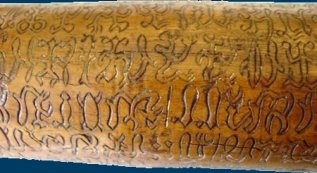 The valley itself hosts the great cities of Harappa and Mohenjo-Daro; cities thought to be 4500 years old, predating the historical society of India. The Indus Valley culture came to a sudden end in about 1500BCE when invaders from the north ransacked the area. The speed of this demise is demonstrated by the fact that skeletons of slaughtered inhabitants have been found preserved at the old street level (45). Along with their destruction went our potential for understanding their ancient script, for their writings are now indecipherable, with their language disappearing along with the extinction of those who spoke it. Yet these people left behind a mystery for us to contemplate. We know they had a distinct script for many of the letters or syllables have survived on seals and other documents. What is remarkable is the similarity of these symbols with those found on the 'rongo-rongo' boards or carved on rocks on Easter Island, the opposite side of the world (above). There are other examples of apparent connections between ancient peoples. Such examples include the Chinese style frieze motifs found at El Tajin and other sites in Mexico, which have a close resemblance to ancient designs from the earliest Chinese dynasties (Hsia, Shang and Ch'ou 2000 to 250 BCE.)
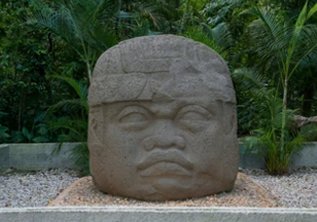
The Olmecs leave further evidence of the global wandering of ancient man. The Olmec culture can be dated to c. 1500 BCE and although little is known of their existence, James and Oliver Tickell refer to their "complex calendar from astronomical observation that underpinned their religion, mathematics and science (47)." Our interest in the Olmecs here stems from the carved heads they left in Mexico (below). Quite clearly the statues show Negroid features, and yet Negroes were supposedly unknown in the Americas until the voyage of Columbus, just as cocaine was supposedly unknown to the Egyptians, despite traces being found in the bodies of a number of Pharaohs.
 In 1952 another find was made that indicates that ancient man wandered far and wide across the surface of the planet. This was the discovery by Dr. Daniel Ruzo of megalithic sculptures in Marcahuasi. Marcahuasi itself is about 80 kilometres north of Lima in Peru and is a plateau at an altitude of 4000 metres, where the air is cold and the landscape barren. There, Ruzo discovered huge figures of people and animals carved out of stone. Lions, cows, elephants and camels, which had never lived in the Americas, surrounded him. He also noted an amphichelydia - an extinct ancestor of the turtle, known only by its fossilised remains. There was also a sculpture of a horse, yet the horse died out in America around 9000 years ago, reappearing in the 16th Century when the conquistadors brought it with them from Spain. There is one obvious answer to this puzzle; the sculptures are simply from the past few hundred years. Yet geologists have analysed the white dioritic porphyry from which the heads were carved, and conclude that the stone would have needed at least 10,000 years to take on the grey tint it now shows in the cuts (48).Then in 1962 on a rocky cliff west of Alice Springs in the heart of Australia, Michael Terry discovered a carving of the extinct Nototherium Mitchelli. This rhinoceros-type animal had disappeared some 2,500 years ago.
In the same place he found six carvings of what appeared to be ram's heads (49) and yet rams were supposedly unknown in Australia until the arrival of the English. It seems that whoever these people were, they knew how to travel, having left behind numerous clues to their wanderings. So who were these people and where did they live?
References
(1) Clarke, Arthur C., Mysterious World p. 96, Book
Club Associates, Norwich 1980.
(2) Clarke, Arthur C., Mysterious World p. 100, Book
Club Associates, Norwich 19800.
(3) Clarke, Arthur C., Mysterious World p. 100, Book
Club Associates, Norwich 1980.
(4) Clarke, Arthur C., Mysterious World p. 97, Book
Club Associates, Norwich 1980.
(6) Natural History Museum 1967
(7) Clarke, Arthur C., Mysterious World Book Club
Associates, Norwich 1980.
(8) Clarke, Arthur C., Mysterious World pp. 91-92,
Book Club Associates, Norwich 1980.
(9) Gorbovsky, A, Riddles of Ancient History, Moscow
1966.
(10) Abanto de Hoogendoorn, N, Chavin de Huantar - A Short
Eternity p39 Lima 1990 in Alford p89.
(11) Alford, A, Gods of the New Milennium p. 88
Eridu Books, Kent 1996
(12) Alford, A, Gods of the New Milennium p. 90
Eridu Books, Kent 1996
(13) Andrew Tomas, We Are Not The First p.38
Souvenir Press, 1972
(28) Olshin, Dr. Benjamin B., Mechanical Mythology: Private
Descriptions of Flying Machines as Found In early Chinese, Korean, Indian and
Other Texts.
(29) Andrew Tomas, We Are Not The First p.72
Souvenir Press, 1972
(30) Andrew Tomas, We Are Not The First p.73
Souvenir Press, 1972
(31) Andrew Tomas, We Are Not The First p.73
Souvenir Press, 1972
(32) Andrew Tomas, We Are Not The First p.76
Souvenir Press, 1972
(33) Andrew Tomas, We Are Not The First p.75
Souvenir Press, 1972
(34) Andrew Tomas, We Are Not The First p.156
Souvenir Press, 1972
(35) Andrew Tomas, We Are Not The First p.157
Souvenir Press, 1972
(36) Andrew Tomas, We Are Not The First p.158
Souvenir Press, 1972
(37) Andrew Tomas, We Are Not The First p.165
Souvenir Press, 1972
(38) Andrew Tomas, We Are Not The First p.165
Souvenir Press, 1972
(39) Andrew Tomas, We Are Not The First p.165
Souvenir Press, 1972
(40) Ezek. XXI, 21 and Genesis XXXI, 34
41) Andrew Tomas, We Are Not The First p.40
Souvenir Press, 1972
(42) Andrew Tomas, We Are Not The First p.166
Souvenir Press, 1972
(43) Roerich, N, The Indestructible Riga 1936.
(44) Berlitz, C Mysteries From Forgotten Worlds p. 36
Souvenir Press, 1972.
(45) Alford, A, Gods of the New Milennium p. 483
Eridu Books, Kent 1996
(46) Berlitz, C Mysteries From Forgotten Worlds p128
Souvenir Press 1972
(47) Berlitz, C Mysteries From Forgotten Worlds p179
Souvenir Press 1972
(48) Tickell, J. & O., Tikal, City of the Maya,
Tauris Parke Books, London, 1991
(49) Andrew Tomas, We Are Not The First p.42
Souvenir Press, 1972
(50) Andrew Tomas, We Are Not The First p.40
Souvenir Press, 1972

|
|

|